By Brad Bowman
When the closest hospital is miles away and there’s no cell signal in the bottom of a Kentucky hollow, you may be your own first responder. Even if you have the ability to use a smart phone, 911 can be miles away. What you do next matters.
Todd Gray, who leads the safety team for Kentucky’s Energy and Environment Cabinet (EEC), has experienced this firsthand. As a former firefighter and EMT, he knows the dangers of working in remote and sometimes precarious environments.
One such experience stands out.
A dirt bike rider with a suspected broken collarbone had crashed in the hills of Eastern Kentucky and was unable to get out on his own. Emergency vehicles could only reach the foot of the mountain, and getting a helicopter wasn’t an option. It left firefighters and EMS personnel with a 20- to 25-minute hike to reach the injured rider, all while packing in safety gear.
“Time is of the essence,” Gray said. “You’ve got to hope they don’t bleed out, that they don’t go into shock. And then when you get there, the fun just begins because you’re treating them and trying to get them off the hillside.”
It is exactly the kind of situation EEC field staff may encounter, Gray thought. And training would help them prepare.
Starting last fall, Gray began researching wilderness first aid programs and put together a training course. He, along with Safety Administrator Blake Ridenour, began offering the courses this year and have provided training in Pineville, Frankfort, Madisonville and Morehead.
Their priority is to train forestry personnel ahead of Kentucky’s October fire season. Other field staff training will continue into 2027.
“Our primary focus right now is the full-time forestry staff to get them all trained and ready to go to where they can provide this kind of knowledge and this skill set for their crews in case it’s needed,” Gray said.
“I’m quite proud to say that the division’s Forest Health Program field staff were actually the first to take the course offered through the cabinet. Guineapigs so-to-speak,” said Alexandra Blevins, EEC’s forest health program coordinator. “Our folks are out there in it almost 100% of the time; hiking through some of the roughest terrain eastern KY has to offer. Not to mention the venomous snakes, lurking bears and angry wasps. This work environment is worlds apart from the office and requires specialized training to keep our folks out of harm’s way.”
Blevins said she sleeps better at night knowing her colleagues are properly trained for the different hazards they may encounter on the job.
“I take pride in knowing that this is now a required training for all cabinet field staff, and we were the first to volunteer, “Blevins said. “I highly recommend this training as safety is truly our first priority.”
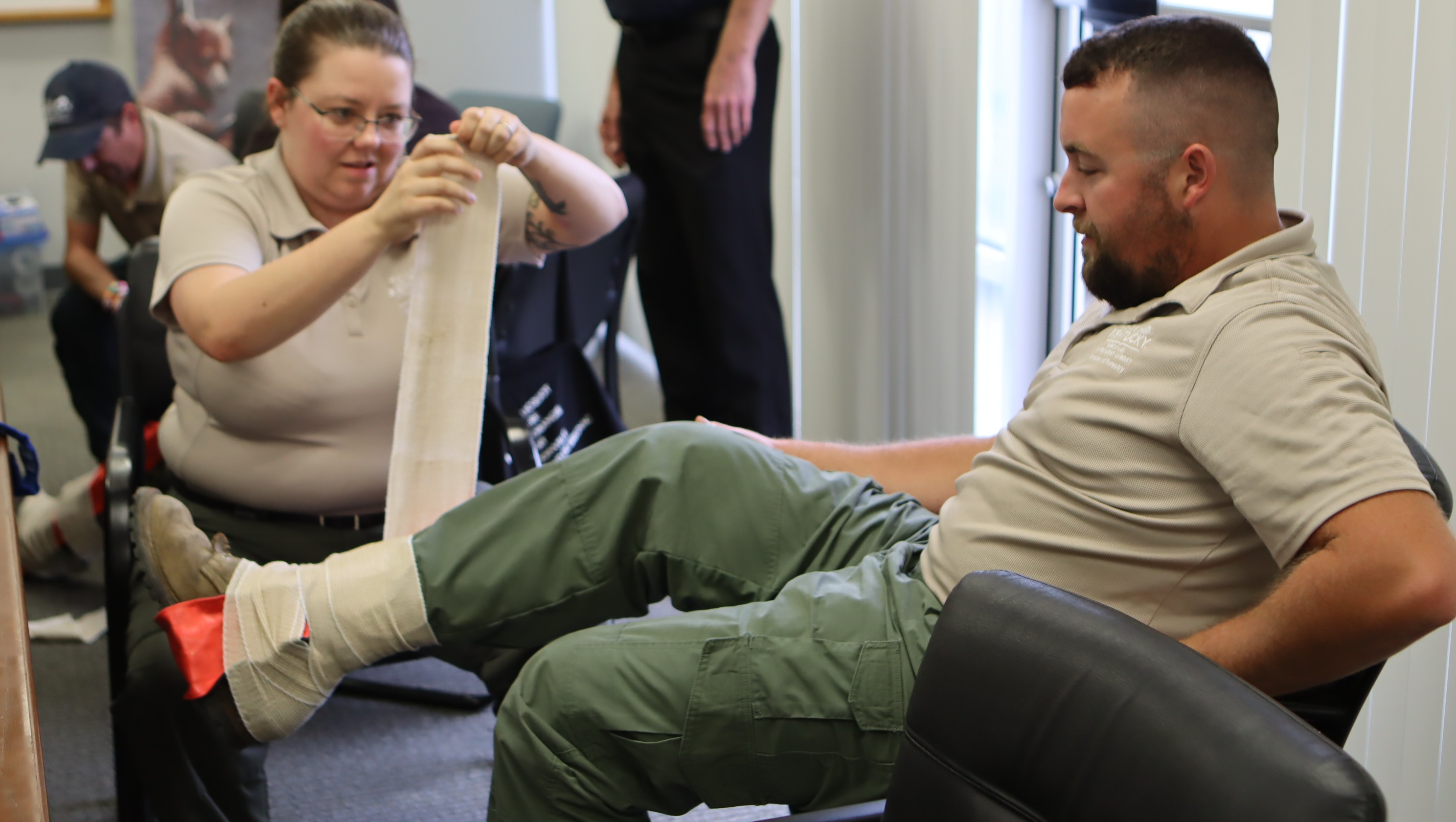
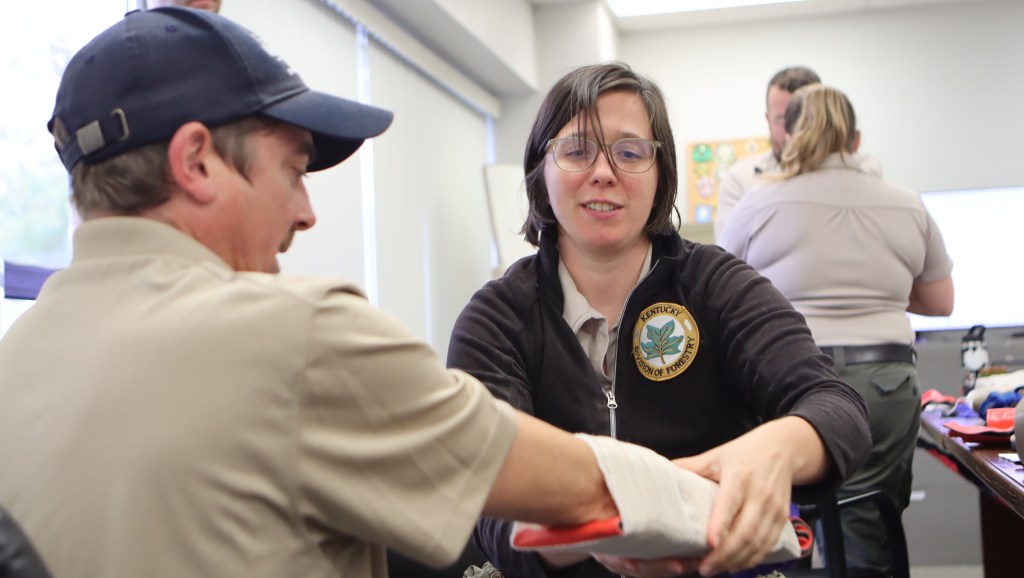
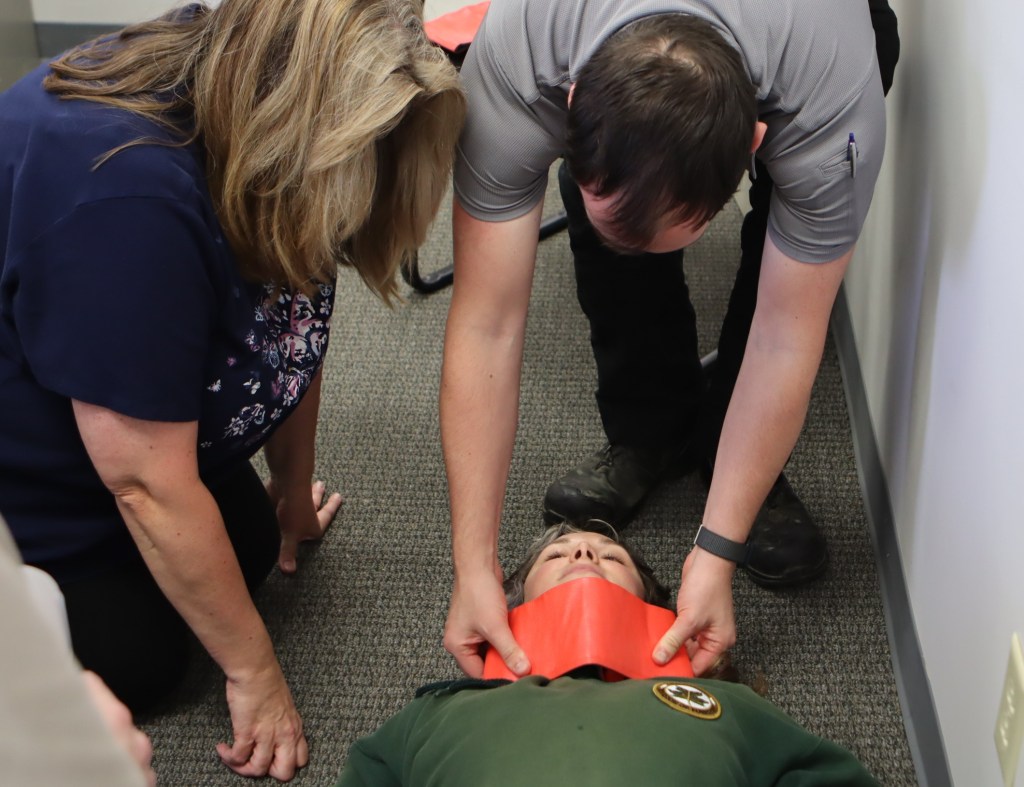
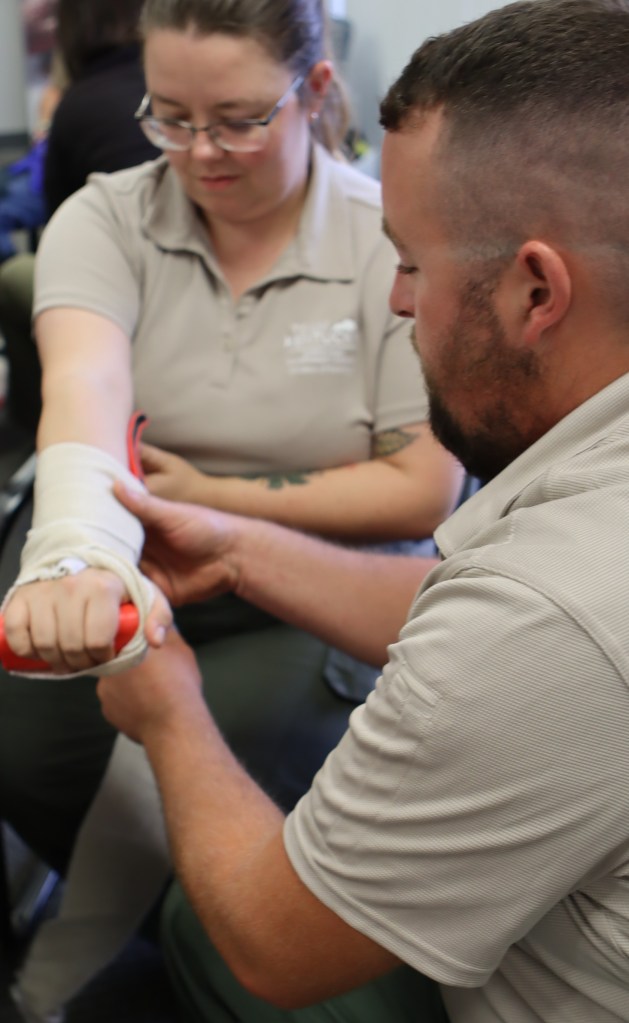
During the class, participants don’t simply hear about first aid techniques. They practice them. Working in small groups, employees respond to simulated injuries and learn how to splint and wrap an injured leg or ankle, support an injured arm with slings and safely roll over someone injured using certain handling techniques to minimize harm.
“This is not just something we read from a book,” Gray said. “These are things that we’ve actually applied in our careers before we got here.”
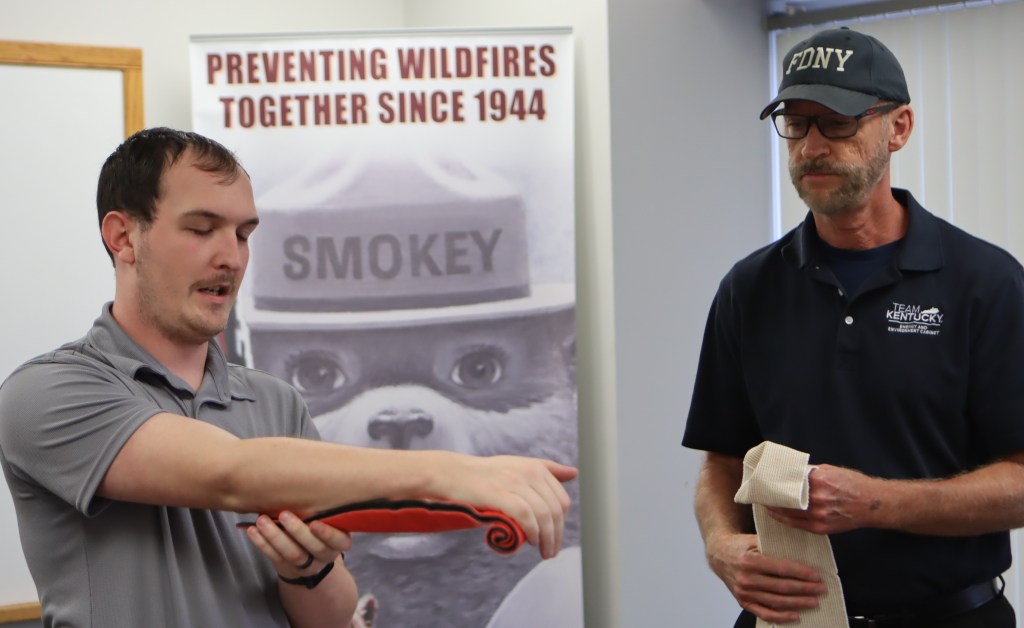
The goal he said, is straightforward: to give employees practical skills they can fall back on when something goes wrong and professional help isn’t just around the corner.
Because in the field, a simple fall, cut or wrong step can quickly become something more serious.
“You’ve got to know it when it happens,” Gray said. “You revert back to, ‘What skills do I have?’ That’s what we try to do, provide that training. We have so many people in the field, I started looking at that and knew we need something for a one-day, standalone, hands-on, remote wilderness kind of first aid.’”
The training is separate from EEC’s existing CPR, automated external defibrillator and first aid course. Additional wilderness first aid classes are already being scheduled into 2027 as Gray works to identify full-time employees who would benefit most from each type of training.
Categories: All, EEC's Blog, Featured, Forestry, Media Gallery