
By Brad Bowman
With gloves on, saws in hand and a bit of shared purpose, community volunteers teamed up with the Kentucky Division of Forestry, Yew Dell Botanical Gardens staff and a small army of Louisville Urban Forestry’s Louisville Equitable Forest Initiative (LEFI) team members to remove invasive plants at Yew Dell Botanical Gardens.
The event highlights the value of collaboration in protecting native plants, creating or maintaining healthier habitats for native species, and improving our ecosystems.
Yew Dell Botanical Gardens Education and Volunteer Coordinator Emma Bryan said she’s thankful for the expertise and help from the Kentucky Division of Forestry. “We don’t have the staff capacity to care for the woodlands like they really need to be and so we’re really thankful,” Bryan said. “…For organizing and getting folks down here. And the knowledge they bring from the cabinet.
Adam Taylor, Kentucky Division of Forestry’s invasive plant coordinator, said the division is focusing on Louisville as a location to develop a Cooperative Invasive Species Management Area, referred to as CISMA.
“It’s the first state-led one of its kind,” Taylor said. “The hope is to do the leg work for a CISMA in Louisville, tap into the partnerships and organizations doing this kind of work and build that CISMA structure and replicate it across the state, maybe [in] every county or through soil and water conservation districts.”
One of those local partners helping at the botanical gardens included Charlotte Jones’ crew from LEFI. As part of LEFI’s funding, the group is planting 5,000 trees in areas of Jefferson County. They also prune and remove dead or hazardous trees. Jones oversees the workforce development program.
“Any kind of work like this: tree planting, invasive plant removal, all has a very tangible and visible impact,” Jones said. “We can all come together en masse and get rid of this stuff to see an immediate difference.”
The bulk of invasive plants comes from homes where they were once considered ornamentals. As early as the late 1800s, popular ornamental plants like honeysuckle were used in landscaping and promoted as a way to control soil erosion and provide wildlife cover, which reportedly led to the spread of the plant by wildlife.
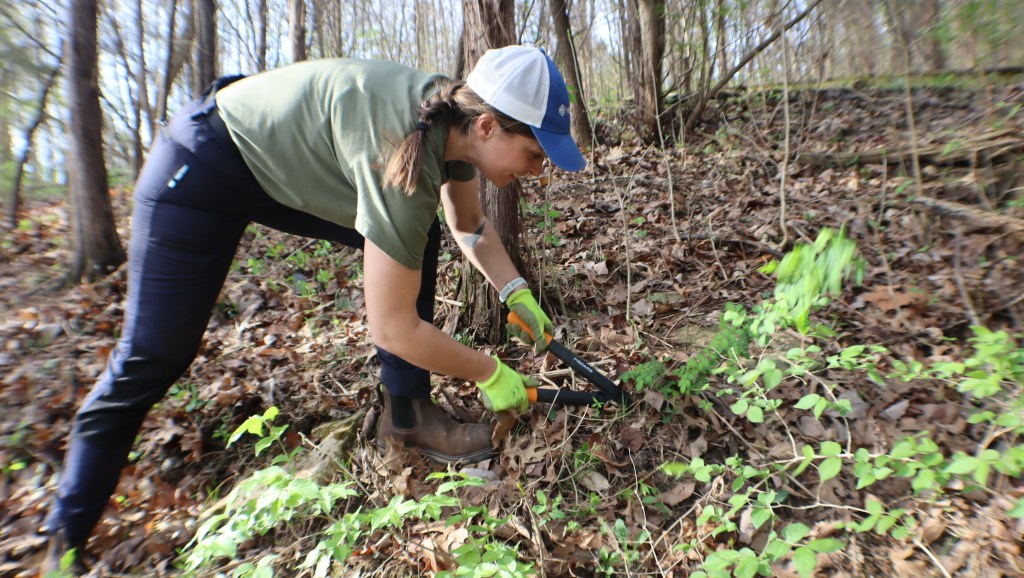
Alexandra Blevins, forest health program coordinator of the Kentucky Division of Forestry, started sawing down what may have looked like a small tree to the untrained eye.
“This is our Amur Honeysuckle bush, one of the most notorious invasives for Central Kentucky,” Blevins said. “This is the one that gets those sickeningly sweet-smelling flowers on it, yellow and white, that turn into those red berries, and those red berries, are like fast food for all of our native birds. Preferably, we would want them eating something like a spice bush, which is a native shrub that has much more nutritional value for our wildlife.”
For homeowners, Blevins said they would want to cut the plant as close to the ground as possible and treat the remaining root or stems with a herbicide you would find at a local hardware store.
Another CISMA invasive plant removal event is tentatively scheduled in May at Yew Dell Botanical Gardens and more locations next month, Taylor said.
“We have an invasive ‘Plant Talk & Walk’ at Prospect City Hall’s library and we’ll proceed to pull garlic mustard and remove invasive plants at Putney’s Pond and Woodlands (state nature preserve) with volunteers on Saturday, May 9th from 9 a.m. – 11 a.m.”
To learn more about CISMA and all upcoming events follow them on Facebook at https://www.facebook.com/share/g/18DxzK51Hc/ and its website at https://www.inaturalist.org/projects/derby-city-cisma .
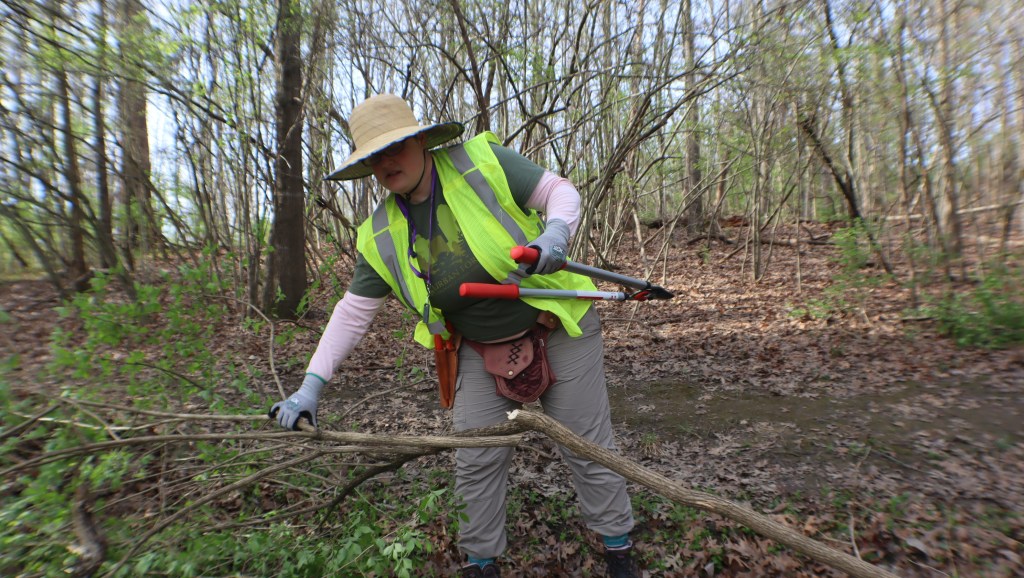
To learn more about invasive plant threats in Kentucky visit: https://eec.ky.gov/Natural-Resources/Forestry/forest-health/Pages/Invasive-Plant-Threats.aspx
For events and outreach programs, follow the EEC on Facebook at https://www.facebook.com/KentuckyEEC and the Kentucky Division of Forestry at https://www.facebook.com/KYDivisionofForestry
For more information on Yew Dell Botanical Gardens special events and volunteer opportunities visit: yewdellgardens.org
Categories: All, EEC's Blog, Featured, Forestry, Media Gallery




 Land, Air & Water