
By Brad Bowman

With more than 20 years of experience within the Division of Forestry, the last four as its director, Brandon Howard is excited to bring his talents and expertise to the Southern Group of State Foresters (SGSF) as its newly elected vice chair of its executive committee.
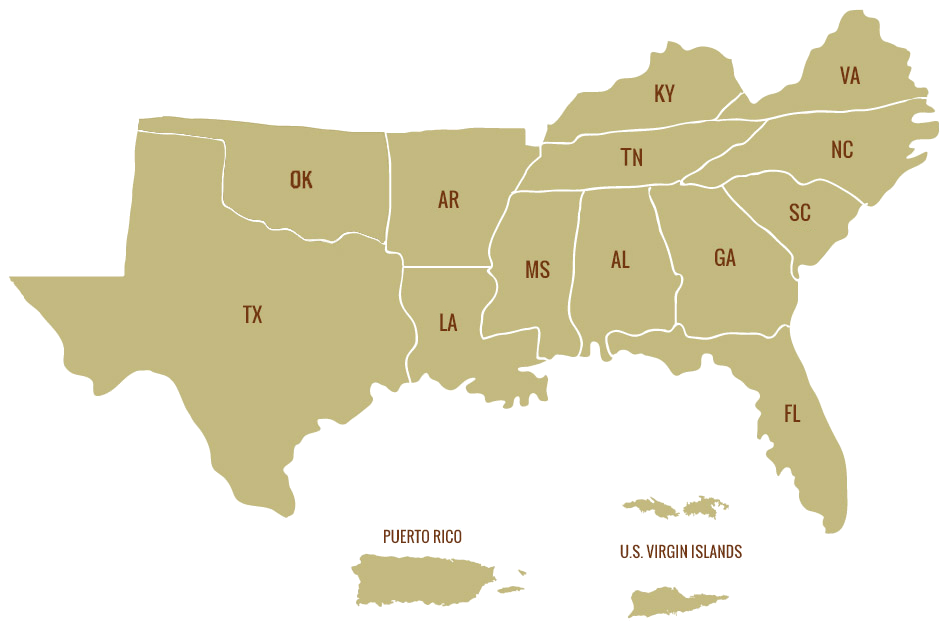
Howard sees this as opportunity for Kentucky to shine within the group’s 13-state region which extends as far south as Texas, the territories of Puerto Rico and the Virgin Islands.
“In Kentucky we have over 12 million acres of forestland and a forest products industry that exceeds $18 billion in total economic impact for the state,” Howard said. “During my time as state forester, I have strived to bring Kentucky to the forefront and show just how great our state is and what we have to offer.”
Bound by the Atlantic Ocean on the east, the Gulf of Mexico in the South, the SGSF provides the southern United States with a voice, Howard said, reminding the nation that wildfires aren’t just a western U. S. issue. SGSF also raises awareness about forest health, forest stewardship, urban & community forestry, and other important forestry matters as they arise, he said.
The group has many vital partnerships that Howard said he wants to build upon as vice chair.
The United States Forest Service’s (USFS) Region 8 geographically mirrors the SGSF’s region and provides supports to states with federal grants and wildfire suppression assistance, Howard said. SGSF has an existing partnership with the National Association of State Foresters (NASF), which coordinates efforts that focus on the importance of the country’s state and private forests. Other federal partners include the USDA’s Natural Resource Conservation Service and the Department of Interior which coordinate with SGSF for a variety of forestry initiatives.
Last year, Howard served as the chair of the Southeastern Interstate Forest Fire Protection Compact. In that role, he assisted other states in mobilizing resource for wildfire suppression. He plans to build upon those efforts in his new role to continue strengthening those relationships.
“I want to foster relationships amongst other states and also federal agencies so that we can continue to work together on all aspect of forestry,” Howard said. “One example would be forest health.”
The pests that threaten our forests know no jurisdictional boundaries, Howard said. He believes that only through working together can we protect our forests from invasive /exotic insects, plants and diseases that threaten them. Understanding where these overlaps occur is key to developing new partnerships and promoting a healthy forest, he said.
But there is another pressing need, Howard said. Agency personnel have changed over the years and their desire to obtain certain levels of qualifications has changed as well.
For out-of-state wildfire assignments, personnel can choose different paths, all which ultimately benefit the Commonwealth with our wildfire suppression efforts. The assignments outside of Kentucky are not mandatory and personnel choose to better themselves through these details.
“What we’ve seen is our personnel’s desire for assignments going to dozers, engines, and various other overhead positions on incident management teams,“ Howard said. “Some of the newer employees would rather support roles in logistics, finance, communications, planning, and other functions. While all these opportunities are good, a solid foundation must be set, and I believe this is done by developing more opportunities for participation in hand crews and encouraging that participation.”
The wildfire community is a family, and “crew cohesion” is critical for a wildland firefighter’s mental and physical wellbeing, Howard said. Firefighters watch each other’s backs in these situations where the risk level to their health is extremely high. With fewer hand crews being dispatched from the Southern Area Coordination Center every summer for details out west, crew cohesion has changed.
One of Howard’s goals at the regional level is to build up hand crew rotations that would bring crew cohesion across the south. With other personnel challenges and wildfire dynamics becoming more complex, the cohesion is more necessary than ever, he said.
“In Kentucky, we had friendships forged on those fire lines from personnel in west Kentucky, all the way to east Kentucky,” Howard said. “When an individual is tasked with battling wildfire, these friendships are critical. Wildfire suppression often involves 16-hour days, with 14 – 21 straight shifts. It involves missing Thanksgiving dinner with family, children’s birthdays, friends’ weddings, all to protect the citizens we serve.”
“While the crew cohesion still exists, the level isn’t what it used to be in years past. This is true all over the south and I believe it is a leading cause of burnout amongst wildland firefighters. This year Kentucky sent out its first hand crew in many years after several attempts to field the 20-person crew. This was an initiative I championed because I wanted our state to build that crew cohesion again, especially for our newest employees.”
Categories: About Us, EEC's Blog, Featured, Forestry, Getting to Know Us, Media Gallery






 Land, Air & Water