
By Robin Hartman and Paulette Akers

In October of 2019, about 2000 athletes were poised for the first leg of that year’s Ironman competition, a 1.2-mile downriver swim in the Ohio River.
But it never happened. Unsafe levels of nutrient pollution had caused harmful algal blooms (HABs) in the Ohio River, resulting in a public health warning.
Excess nutrients such as nitrogen and phosphorus continue to have negative impacts on Kentucky’s water quality, including causing an overgrowth of algae in a short period of time, also called algal blooms. The overgrowth of algae consumes oxygen and blocks sunlight from underwater plants. When the algae eventually die, the oxygen in the water is consumed.
The formation of toxic harmful algal blooms (HABs), especially prevalent in warmer weather months, disrupt fishing and swimming, harm aquatic life, and increase drinking water treatment costs. Farm ponds can also be affected, causing sickness and even death in livestock.
Nutrient pollution in Kentucky also affects downstream coastal waters and regional seafood markets in the Gulf of Mexico. Nutrient loading to the Mississippi River Basin is the leading contributor to the hypoxic zone (or dead zone) in the Gulf of Mexico off the coasts of Louisiana and Texas.
A 2021 USGS study in the Journal of the American Water Resource Association estimated Kentucky contributes 112,374 tons of nitrogen to the Gulf of Mexico each year, the seventh highest of states bordering the Mississippi. The study also estimated Kentucky’s total annual phosphorus contribution at 25,116 tons per year, which places Kentucky third highest among bordering states.
Farmers and landowners are stepping up
One group in particular – farmers and landowners in Kentucky – are taking notice and stepping up to do their part to improve the Commonwealth’s waterways. They’re using tools like the Energy & Environment Cabinet’s Agriculture Water Quality Plan, which provides examples of best management practices for landowners to help increase efficiency and farm production while reducing nutrient loss and the negative impacts on water resources.
Through a little ingenuity, Joseph Sisk reduced the nitrogen loss on his Christian County farm by 3,203 pounds per year, reduced phosphorus loss by 982 pounds, and sediment loss by 569 tons. While good for his farm, it’s also good for the quality of nearby streams and rivers, the community’s drinking water, and ultimately, the Gulf of Mexico.

When an area of crop field that had been repaired many years prior began flooding again, Sisk knew changes in the watershed were the cause. He removed silt from the flooded area and reestablished the grassed waterway. The improvements have lessened field erosion during storm events and have prevented the loss of crops.
Sisk serves on the Kentucky Agriculture Water Quality Authority, a group representing the state’s agriculture and environmental community.

“Every producer in the state of Kentucky should have an Ag Water Quality Plan,” Sisk said during a recent podcast. “It’s online now, and it’s easy to get on and do it,” and he says it encourages farmers to look at best management practices and to think about things they may not have considered that may impact farm production and the area’s water quality. Farmers can also fill out a plan at their local conservation office.
Financial and technical assistance are available through the Kentucky State Cost Share Program to help agricultural operations protect their soil and water resources and to implement their agriculture water quality plans.
Jon and Sylvia Bednarski, owners of Sherwood Acres Farm in Mercer County, have applied several practices to support their farming operation over the years. From planting more than 400 trees to create riparian buffer and fencing cattle out of a creek and wooded areas, to constructing feed pads and rocked gateways to decrease mud. Every project, they said, improved their farm production while protecting the surrounding watershed.

Jon’s favorite project by far is a heavy-use area for winter feeding. This graveled, 1924-square-foot area was built in 2018 with assistance from the Mercer County Conservation District and the local Natural Resources Conservation Service (NRCS) office. It nicely accommodates the 32 cattle at the farm.
“I hate mud!” he said. “With this structure I never get the tires of my tractor muddy anymore. I’m always on gravel.”
The Bednarskis received $15,000 in state cost share financing to help with the construction. “Getting connected with the local conservation district and NRCS office were great for a first-time farmer like me,” Jon Bednarski said.

Imel’s Greenhouse in northeastern Kentucky is also meeting the challenge to reduce its environmental impact. The Imel’s working farm in Greenup started small, with only one 28X48 foot building as a greenhouse providing plants to local retail stores. But with the development of agrotourism in Kentucky over the past 20 years, their retail sales have grown from 10 to 90 percent.
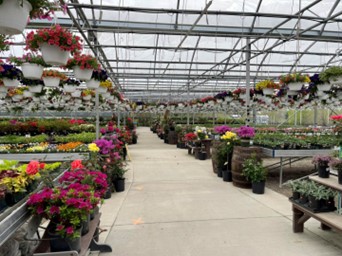
In May 2020, the Imels installed their first ebb and flow bottom-feed watering system in one of their greenhouses. This allowed plants to hold water longer and caused less damage to flowers than watering from above.
A $40,000 grant from the Kentucky Ag Development Board was used to install the bottom feed tables. With the savings incurred, the system paid for itself in the first year. “I know it is an expensive investment, but I won’t build new greenhouses any other way,” Imel said.
Before the system was installed, the family hauled 4,000 to 6,000 gallons of water each day to manually spray the plants. Water for the new system is harvested from the roof, with a one-inch rainfall event capturing 12,000 gallons. The bottom feed system uses about 2,500 gallons a day, but it recycles the water, so less is wasted.
“A person just can’t water evenly,” Kenny Imel said. “This way the water comes up evenly for use by the plants and we have drip irrigation for the hanging baskets.”

As a result, they’ve have been able to shift the job duties of two staff people from watering all day during the growing season. There are also big savings for the family and for the environment in terms of nutrients. The Imels also have reduced fertilizer use from 2,000 to 250 pounds.
Best management practices like these, as well as resources for technical and financial assistance, recommendations and other resources are available through the Ag Water Quality Planning Toolkit. Landowners of 10 acres or more that are being used for agriculture or silviculture operations should implement a water quality plan and keep it updated.
Find the toolkit at https://eec.ky.gov/Natural-Resources/Conservation/Pages/AgWaterQualityPlan.aspx. To learn more about nutrient reduction in Kentucky, visit https://eec.ky.gov/nutrientreduction.
Categories: All, EEC's Blog, Environmental Protection, Featured, Water






 Land, Air & Water