
BY AIDAN DILLARD-HIJIKATA

Crawfish, crayfish, crawdads or mudbugs.
Whatever you call the palm-sized freshwater crustacean, it conjures ideas of traditional Louisiana culture. Gigantic pots, filled to the brim with crawfish, boiling the oversized water bugs for a later feast, are so deeply tied to Creole and Cajun culture that the sheer reach of the creature’s habitat is often forgotten.
In Kentucky, hundreds of burrowing crayfish emerge from their underground safe havens to meet the thawing soil as the groundwater table rises from the spring rains. This phenomenon attracts people from across the country — not to consume them, but to study them.
Aptly called Mudbug Mania, the annual event is held in partnership with various academic and governmental entities, including, but not limited to, the Office of Kentucky Nature Preserves, Kentucky Department of Fish and Wildlife Resources and the Tennessee Wildlife Resources Agency.
The event as a whole was very beneficial to the study of the crayfish. Kentucky has 70 documented species, but it is estimated that another 20-30 more species are undescribed in the state, so the event as a whole was extremely beneficial for the study, monitoring, and conservation of crayfishes in the Commonwealth. Some 150 sites were surveyed, and at least 22 different species of crayfish were encountered, one of which could potentially be a new species that was never formally documented in Kentucky, pending genetic assessment.
Mudbug Mania 2025 achieved approximately three years of work in one week and saved the state approximately $100,000 in monitoring and management, said Office of Kentucky Nature Preserves Aquatic Biologist Mike Compton, one of the event’s organizers.
“For me and one other person to go out to Western Kentucky and conduct all of the surveys during Mudbug Mania, it would take 3 years [at] ~50 surveys per year,” Compton said in an email. “I frequently say, ‘Conservation is a Team Sport.’ I wholeheartedly believe this if we are to make any progress in conservation.”
Nestled down a bumpy country road on the west side of the Land Between the Lakes, the Hancock Biological Station in Calloway County is a Murray State facility that acts as a field research outpost for biologists to study the unique biotic community of the surrounding area.
On May 22, 2025, room 204 hosted a diverse cast of characters. Some were researchers, others bright-eyed graduate students, and a handful worked for the different interested environmental divisions of state government. No matter where they came from, they were there for one unifying reason: to study crayfishes, such as Faxonius kentuckiensis, or the Kentucky Crayfish.
Biologist Zachary Loughman, Ph.D, whose work focuses on crayfish, travelled from West Liberty University in West Virginia and taught the room how to determine the gender of crayfish specimens and what characteristics change between species. He also generally prepared his class on the proper protocol for the survey/study, which occurs directly after the short course is finished.

“To a crayfish nerd like me, it’s a crayfish state,” Loughman said of Kentucky. “[It has] multiple major habitats. It has the largest crayfish species in North America.”
Dr. Loughman met Compton years ago due to a mutual interest in the crayfish. Together, Dr. Loughman, Compton and other astacologists unify under the banner Kentucky Crayfish Collective, “[…] an assemblage of regional aquatic biologists from government agencies and academia who work together to enhance the awareness, knowledge and conservation of crayfishes,” Compton said. This eventually distilled down into the Mudbug Mania event.
“[Kentucky is] a rare state with a crayfish book. It let me see what was there.” Functionally an almanac, the book Dr. Loughman referred to covers the different crayfish species and populations. However, this book is now considered outdated, having come out some two decades ago. Dr. Loughman used the book as a basis for his research, having now expanded far beyond the scope of the original text.
“Very little was known about burrowing crayfish [when the almanac was released]. That’s why they’re called mud bugs,” he continues. “The Painted Devil Crayfish, there were two dots in Kentucky because it was hard to get them out of the ground when the book was published. Mudbug Mania this year brought that number to 10; it fleshed it out.”
A half-hour away, on the side of the road inside the Blood River Seeps Nature Preserve, stands one John Brumley, an environmental biologist supervisor for the Kentucky Division of Water. He walks unfearingly over the rumble strips as Super-Duty trucks and church vans blaze past him at highway speeds.

Like Dr. Loughman and his students, Brumley is deeply interested in the crayfish population in Kentucky, but for a different reason. “As part of delineating wetlands, you have to establish if there are hydrologic features,” Brumley explained in a later interview. “One of those is crayfish burrows.”
They are an excellent indicator of an ecosystem’s health. When the ecosystem changes due to pollution or other environmental factors, the weaker species die out, and the heartier ones take over. If, throughout the research segment of the event, one heartier species is discovered at a higher frequency than the weaker ones, an assumption can be made that there is some sort of environmental degradation behind the population shift.
Brumley is a shaman of sorts to the underground complexes of the crayfish, leading his fellow researchers on the pilgrimage to their dwellings.
He has a particular affinity for this nature preserve, proudly proclaiming, “It’s what nature preserves are supposed to look like; what they used to look like.” According to him, the diverse flora and fauna can be attributed to the previous purchaser of the land, who allowed it to grow freely, relighting the proverbial pilot light of the environment contained within.
He knows his way around the nature preserve very well. During the entire walk to the research outpost, he shared colorful anecdotes about the vegetation covering the ground, which ones will and won’t sting, how great the preserve is and how big the trees can grow here. Much of his knowledge on the assorted flora of the preserve comes from his primary focal point, career-wise: botany of the wetland regions in the state.
The path that he takes is unmarked and untrodden, covered in sticks and rocks and leaves, necessitating the use of a walking stick to circumvent the tripping danger.
When there is a small break in the leaf coverage, piles of what he described as “lookin’ like deer scat” are visible. The wet, brown mush isn’t an excrement pile, he explained. It is instead the “chimneys” the crayfish create, the tallest of which can be one or two feet tall. They serve as primitive air flow controllers, ventilating the hideaway holes that can stretch three feet underground.

A short hike later, Brumley rendezvoused with his two associates. Both graduate students, Pat Allison, Jr. and James Rodgers, have traveled a long way to help Brumley research the mudbugs. The former is from the University of Mississippi, while the latter is from Auburn University in Alabama.
Both are covered in mud. But, there is an overwhelming sense of camaraderie among the three men, all working for the same goal: research and discovery of the greater ecosystem around the crayfish.
As for the boots on the ground, Rodgers and Allison take turns digging a hole underneath a crayfish mound, using a plunger-like object to force water out the other end, then capturing the crayfish when they surface and gently placing them in a bucket nearby. Surprisingly, the crayfish don’t seem to mind very much, and neither do the men.
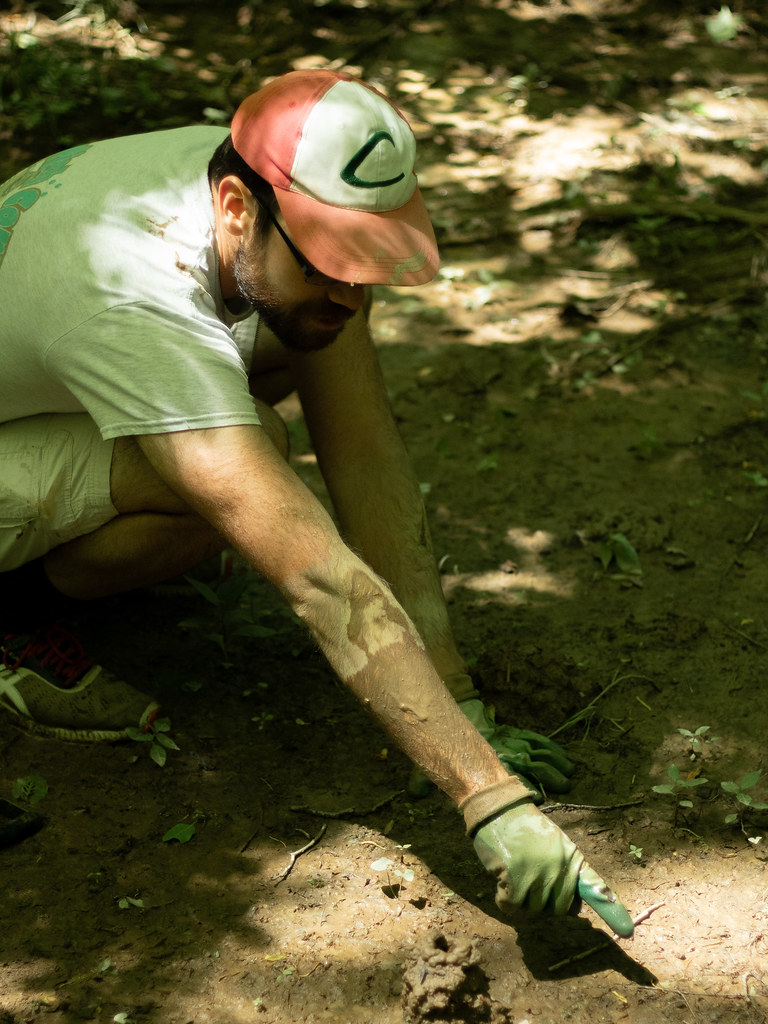
(KY EEC/AIDAN DILLARD-HIJIKATA)
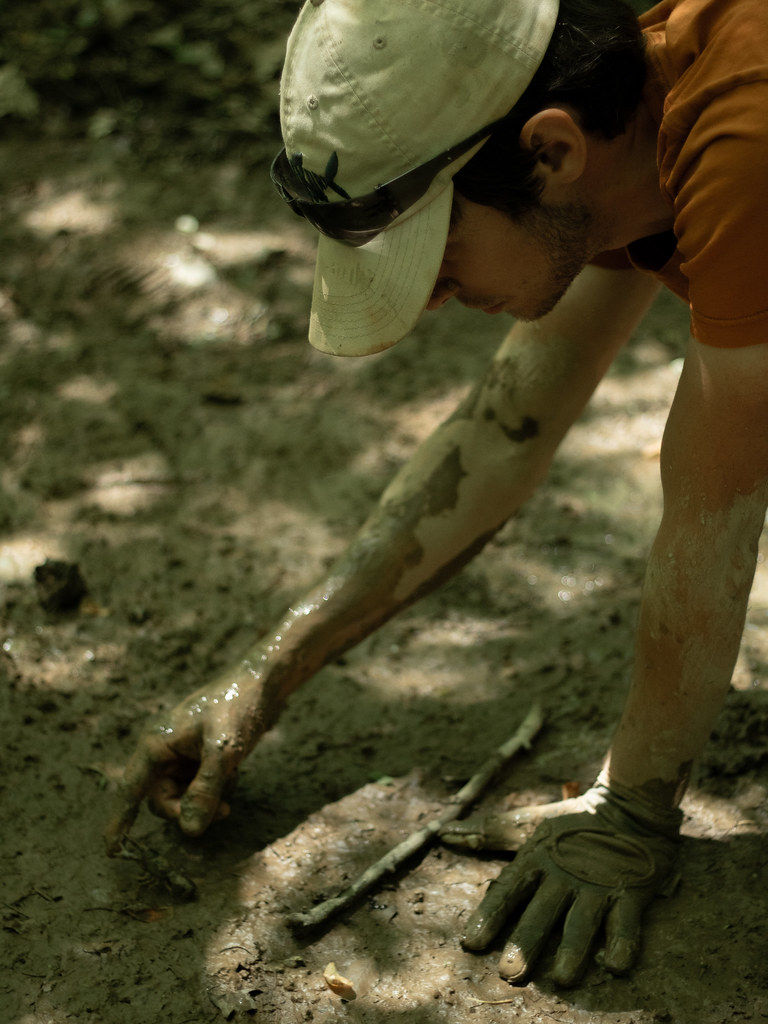
(KY EEC/AIDAN DILLARD-HIJIKATA)
“Crayfish people go to the bar,” says Rodgers, “then go out to the ditch around back and check for more crayfish.”
“It’s all about crayfish,” responds Allison. And he’s right. During Mud Bug Mania, it is all about crayfish.
Categories: Archive, EEC's Blog, Featured, Media Gallery, Nature Preserves





 Land, Air & Water