
BY AIDAN DILLARD-HIJIKATA

“How do we balance the quality of life and the quality of the environment?” That may be a loaded question, but it’s one that the National Conservation Foundation (NCF) has encouraged young, aspiring environmentalists to consider.
The Foundation’s sustainability project, Envirothon, hosted annually since 1999 (although it had numerous different iterations of itself before then, with the earliest recorded occurrence being the 1979 Enviro-Olympics), was created to help “develop knowledgeable, skilled and dedicated citizens who have an understanding of natural resources and who are willing to work towards achieving and maintaining a balance of life, and the quality of the environment,” according to the program’s website.
Much like Governor Andy Beshear’s KY E3 energy strategy, which is built on a three-pillar concept (environment, energy and economy) and encourages collaboration, the Envirothon competition fosters teamwork through competition. One of the foremost goals is to get everyone involved; all make a noteworthy contribution.
Among other environmental think tanks, the Envirothon occupies a unique place. Only students between grades 9-12 (or ages 14-19) can enter the competition, allowing the next generation of naturalists to show their strength in their prospective field. The students are mostly from the United States and Canada, although other countries, notably Japan, China and Singapore, infrequently send their best and brightest.
The event has been specially curated to test students’ abilities in five different sustainability fields: aquatic ecology, forestry, soils and land use, wildlife and current environmental issues. They are judged based on the merit, accuracy and quality of their work and are either eliminated from the competition or advance to the next level.
Throughout the competition, the participants must have a strong theoretical and practical understanding of the environment. Each section has a written field test paired with a hands-on activity related to the chosen topic of discussion. This year’s event focused on the theme, “Roots and Resiliency: Fostering Forest Stewardship in a Canopy of Change.” Notably, though, some of the event’s stations are tied into the theme, while others are general knowledge questions.
Penny Warwick, president of the Kentucky Association of Conservation District Employees, stated that the students “[Were] asked questions on the impacts of climate change on forest ecosystems and management practices that enhance forest resilience […]”
“The theme (forest stewardship) encourages students to examine how deforestation and climate-induced changes affect aquatic ecosystems in addition to other aquatic objectives. […] The kids were asked how soil composition and land-use practices influence forest health and resilience. […] They were also challenged to learn how wildlife populations and biodiversity were impacted by environmental changes,” she explained further.
The competition is broken into two major segments, the National Future Farmers of America (FFA) division and the international division. “The FFA side of the program piggybacks off the international one,” explained Warwick. At their core, they are two separate but equal competitions.
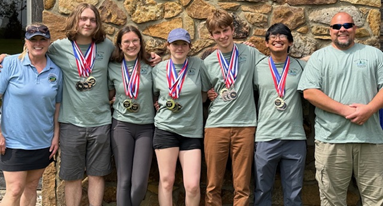
The Bluegrass State hosts regional and state championships yearly between April and May. This spring, the improvisation and adaptation of the Gatton Academy (Warren County), also coached by Penny Warwick, shone through and allowed them to take the first-place medal and advance. They will be competing for the international competition’s trophy in Calgary, Alberta, Canada, between July 20th and July 26th.
The other teams that competed in the competitions, including Fayette County and Greenwood High School (Warren County), also placed high enough to receive commendations and awards. The former scored the highest in the forestry and aquatic ecology sections, while the latter tied with Gatton in the current issues section. Both Gatton and Greenwood scored a perfect 100 in each section.

“I think it just encouraged my interest in environmental policy and gave me a better understanding of, sort of, the Kentucky version of it,” Helen Rose, a student from Gatton Academy, said in an interview with the Bowling Green Daily News.
In the same interview, Sydney Putnam, another student from Gatton Academy, explained that she’s “[…] seen firsthand what invasive species can do to the environment, and Envirothon has helped me to connect these observations and experiences to a broader context and learn what steps government agencies are taking to deal with these issues.”
Empowering the next generation of environmentalists through initiatives, events and programs like Envirothon opens a direct pathway to a sustainable future where everyone protects our planet.
Categories: All, Featured, Media Gallery





 Land, Air & Water